


Wednesday November 12th marked the end of an era. It wasn’t the curtain call for a product or service. It wasn’t the last episode of a popular show. It wasn’t the death of someone important, and it is not something worth a fortune. Truthfully, it’s something worth only one measly cent.
I’m talking about the penny, and on that day the last penny was minted in Philadelphia.
The primary reason for its death is that it costs nearly four cents to mint the coin, which means it is a money losing proposition for the US Treasury. Our monetary system is money by fiat, meaning its value is determined in a “because I say so” declaration from the government. It is legal tender, whether coinage or paper currency. The US abandoned the gold standard—meaning that money could be exchanged for gold—in 1971.
Too bad that declaration about the penny came long ago, when pennies could be minted far more cheaply, and they actually had some value. Not anymore.
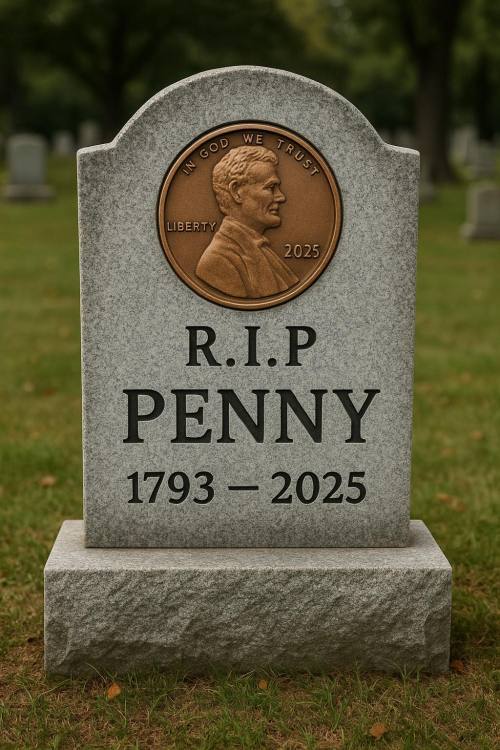
For my mostly younger student audience, the penny could once buy things. Not much, mind you, but a gumball here and there and assorted candies. They were actually worth the energy required to bend over and pick one up from the sidewalk if you spied one. As much as I am in favor of burning calories, I can’t justify stooping for a penny, and probably not for a nickel or dime either.
Already retailers have been begging customers to either pay with exact change, or use an electronic form of payment. Coins of all value have been in shrinking supply as people made the shift toward going cashless, no doubt tucked away beneath sofa cushions, dropped into a cupholder in vehicles, or stored in coffee cans. Guilty as charged. I have coins everywhere except my pockets.
But with pennies destined to fade away even more in the future, retailers are now left trying to figure out what to do. Retail prices typically end in odd numbers, and once sales tax is applied, anything goes. There’s only a 20% chance the total will end in a 5 or 0. Some retailers are rounding, typically down, but it could work the other way as well.
It would be great if retailers would simply post prices that include the taxes, and have already been rounded to a 5 or 0, but then they wouldn’t be able to employ psychological pricing. At some stores, the ending number is actually a code that signifies whether an item is being closed out permanently, so it can convey information to employees. Otherwise, 7 or 9 is used to give the impression that the lowest possible price has been carefully calculated, as well as to stay just a hair below a higher price threshold. How else can you explain that tenth of a cent that is used at the gas pump?
The penny is not alone in costing more to mint than it is worth. It costs 13.5 cents to mint a nickel. Fortunately, it costs a little less than six cents to mint a dime, and 15 cents to mint a quarter. The Treasury thus makes a profit on those coins. Remember, money by fiat.
By now you are probably thinking this is all a moot point, because 86.9% of all transactions in the US are cashless. This is predicted to rise to 94.1% by 2027. Cash customers may very well be the latest to join the Luddite party. Electronic transactions solve the problem immediately, and it doesn’t matter what the ending number is.
And that is the point of this blog. I realize we discussed this phenomenon recently with regard to palm pay at Whole Foods, but this reflects the broader trend. We are just not paying with cash. Between e-commerce, Apple wallet, tap to pay, and so forth, it’s just easier. And, in the event your wallet is stolen, or even your identity, you can quickly turn off all those plastic cards. If someone steals your wallet full of cash, that’s on you.
Meanwhile, the penny will continue to be accepted as legal tender, even though no more will be minted. And you might want to stash some of those stamped 2025, because your grandkids may one day marvel over a coin that to them will seem even more worthless than it is today. That old phrase, “Penny for your thoughts,” will have to be inflated to 50 cents, and even then it might be a stretch.
Maybe you can just Venmo them a more appropriate amount. Who carries coins anyway?
Dr “Thoughts Starting At $5” Gerlich

